Real Pool Answers Without the Guesswork
Pool care can feel confusing because many problems look the same at first. Cloudy water, green water, weak chlorine, high pH, poor circulation, and dirty filters often overlap. This page answers common pool questions in plain English, with a focus on above-ground pools and everyday backyard maintenance.
Use these answers as a starting point, then test your own water before adding chemicals. A clear pool usually comes down to three things working together: proper sanitizer, balanced water, and enough filtration.
Popular Pool Questions
- Why is my pool cloudy even when chlorine looks fine?
- Why did my pool turn green overnight?
- How often should I test my pool water?
- How long should I run my pool pump each day?
- When can I swim after shocking the pool?
- Why does my pool pH keep changing?
- Why are air bubbles coming out of my return jet?
- Why does my chlorine disappear so quickly?
- Why did my pool water turn brown after adding chlorine?
- Why does my pool liner feel loose after heavy rain?
- Why are insects constantly ending up in my pool?
- How can I tell if my pool is leaking or just evaporating?

Most Common Pool Questions
Why is my pool cloudy even when the chlorine looks fine?
Cloudy pool water does not always mean there is no chlorine. It often means the pool is fighting something the filter has not removed yet. The water may contain fine debris, dead algae, sunscreen residue, pollen, or particles too small to settle quickly.
The first thing to check is circulation. Make sure the pump is moving water strongly, the skimmer basket is clean, the return jet has good flow, and the filter pressure has not climbed too far above its clean starting pressure.
Pool Adviser Tip
If the pool is cloudy but blue, think filter and balance first. If the water has a green tint, treat it as an algae problem.
Why did my pool turn green overnight?
A pool usually turns green when algae gets ahead of the sanitizer. This can happen fast in hot weather, after a storm, after heavy swimming, or when the pump has not been running long enough.
Green water is not fixed by adding random products one after another. The pool needs chlorine, brushing, circulation, and filtration working together.
How often should I test my pool water?
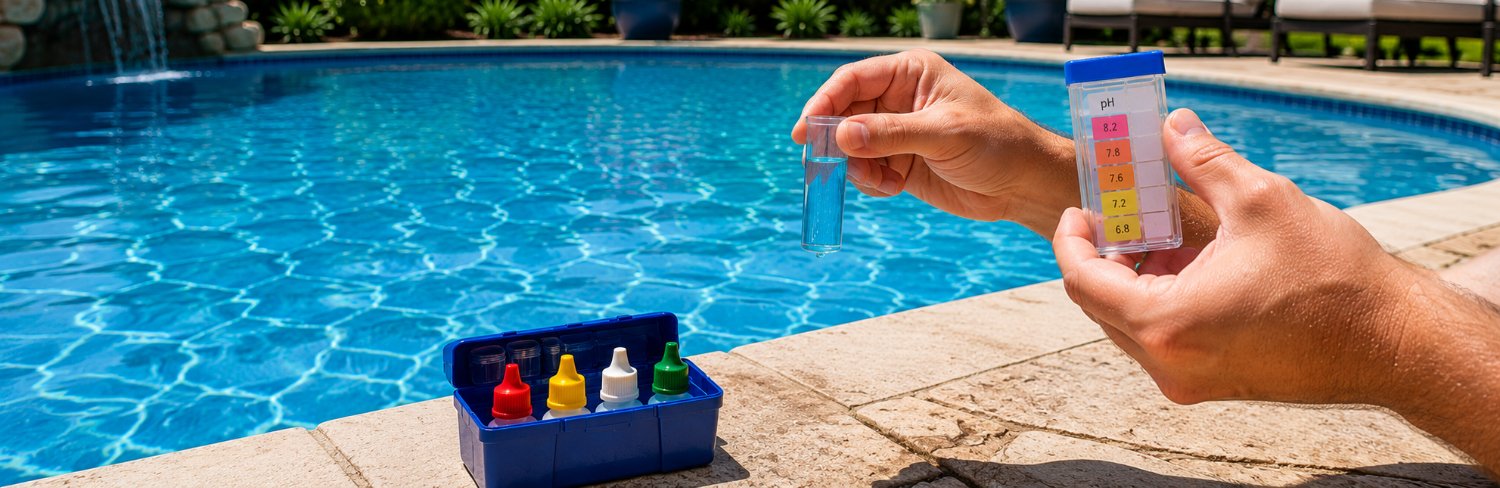
During pool season, test chlorine and pH at least two or three times per week. Test more often during heat waves, heavy swimming, after rain, after shocking, or anytime the water starts looking dull.
Do not rely only on how the water looks. Clear water can still be poorly balanced, and cloudy water can sometimes have chlorine present but poor filtration.
How long should I run my pool pump each day?
Most above-ground pools need enough pump time to move and filter the full pool volume at least once per day. In hot weather, many pool owners start around 8 to 12 hours per day and adjust from there.
Pump time is not only about filtering dirt. It also helps distribute chlorine, move water from dead spots, and keep algae from settling on walls and steps.
When can I swim after shocking the pool?
The safest answer is not a fixed number of hours. It depends on the product used, the amount added, the pool size, sunlight, water temperature, and circulation.
Wait until the chlorine level has returned to the normal swimming range on your test kit, the water is clear enough to see the bottom, and the pump has had time to circulate the treatment through the pool.
Safety Note
Never swim in cloudy water if you cannot clearly see the bottom of the pool.
Why does my pool pH keep changing?
pH drift is one of the most frustrating pool problems because owners keep adding pH up or pH down without fixing the reason it keeps moving. Rain, refill water, aeration, splash-out, chlorine type, and total alkalinity can all affect pH.
If pH keeps rising or falling, test total alkalinity before making another adjustment. Alkalinity acts like a buffer and helps keep pH more stable.
Additional Pool Questions & Troubleshooting Tips
Why are air bubbles coming out of my pool return jet?
Air bubbles returning to the pool usually mean air is getting into the system before the pump. Common causes include a loose pump lid, worn lid O-ring, low water level, cracked hose connections, or a skimmer drawing in air.
Start with the simple checks first. Raise the water level if it is low, clean the skimmer basket, tighten hose connections, and inspect the pump lid O-ring.
Why does my chlorine disappear so quickly?
If chlorine tests normal one day and nearly zero the next, sunlight may be destroying it. Many outdoor pools need stabilizer, also called cyanuric acid, to help protect chlorine from UV rays.
Heavy swimmer use, organic debris, algae growth, and high temperatures can also consume chlorine faster than expected. Before adding more chlorine, test the stabilizer level and make sure the pool is not fighting early algae.
Why did my pool water turn brown after adding chlorine?
Brown, yellow, or rusty-looking water after adding chlorine is often caused by metals in the water, especially iron. This is common when filling from well water.
Chlorine oxidizes dissolved metals, making them visible in the water. A metal treatment product and proper filtration can often clear the problem without draining the pool.
Why does my pool liner feel loose or float after heavy rain?
Vinyl liners can sometimes lift, wrinkle, or feel loose when groundwater pressure builds beneath the pool after heavy rain. This is more common in areas with poor drainage.
Avoid draining the pool immediately. Removing water can reduce the pressure holding the liner in place and may make the problem worse.
Why are insects constantly ending up in my pool?
Pools naturally attract insects because they provide a water source. Ants, bees, wasps, and other bugs may land on the surface and be unable to escape.
Skimmer socks, good circulation, and removing nearby standing water can reduce the problem. If insects suddenly increase, inspect nearby mulch, landscaping, and damp areas.
How can I tell if my pool is leaking or just evaporating?
A simple bucket test can help. Fill a bucket with pool water, place it on a pool step, and mark the water level inside the bucket and on the pool wall. After 24 hours, compare the water loss.
If the pool loses much more water than the bucket, a leak may be present. Check hoses, fittings, skimmer connections, return jets, and wet areas around the pool before assuming the liner is damaged.
Pool Adviser Tip
Hot, windy weather can cause noticeable evaporation, especially in above-ground pools. The bucket test helps separate normal water loss from a possible leak.